Vigenère Cipher vs One-Time Pad: Key Differences
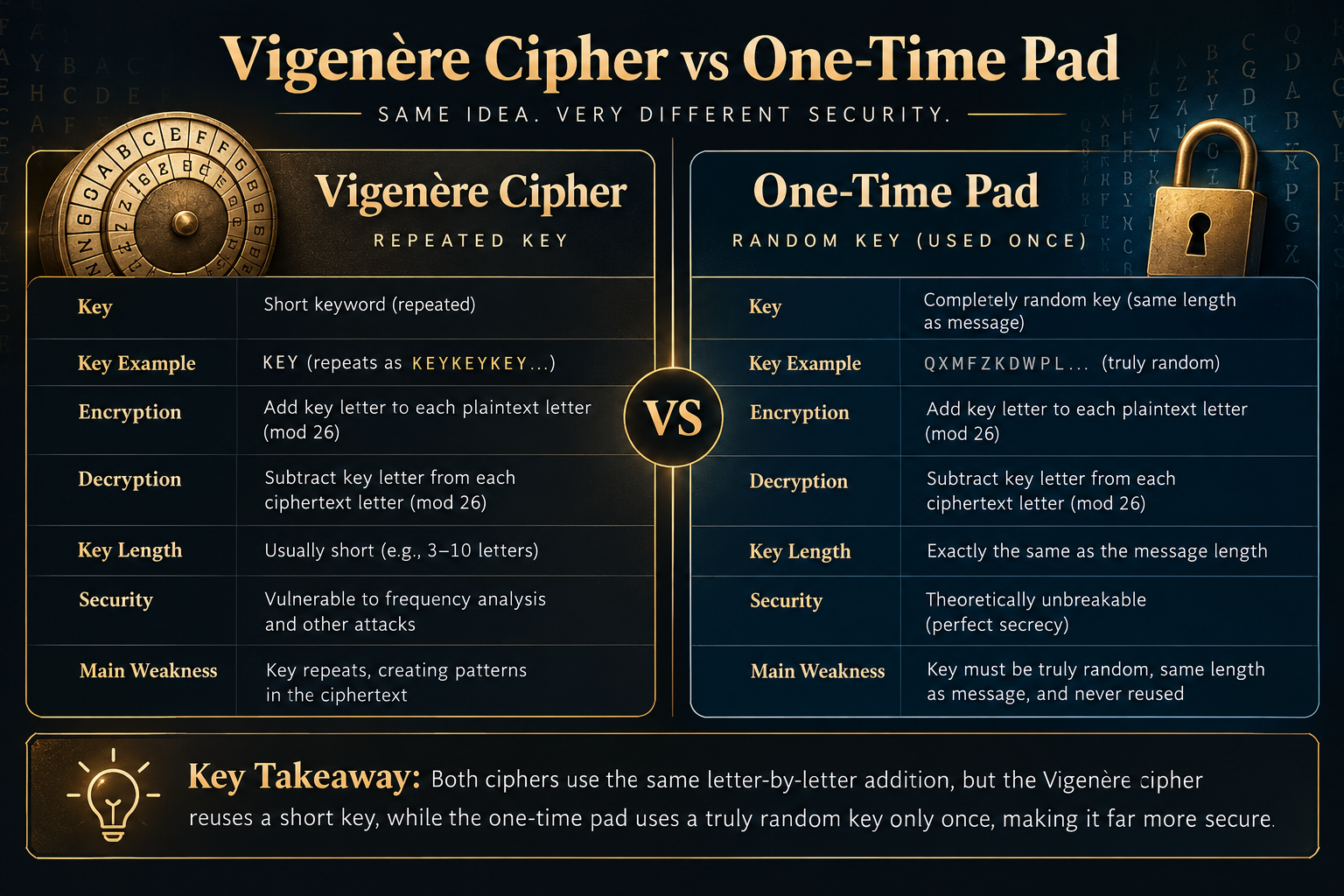
The Vigenère cipher and a one-time pad can perform almost the same letter-by-letter arithmetic and still have radically different security.
With an A–Z alphabet, both can represent letters as numbers from 0 to 25 and combine plaintext with a key using addition modulo 26:
The decisive difference is not the addition.
Traditional Vigenère uses a relatively short key that repeats. A one-time pad uses secret key material that is uniformly random, covers the entire message, and is never reused.
Under those conditions, the one-time pad can provide perfect secrecy. Repeating-key Vigenère cannot.
If you want to experiment with the ordinary repeating-key cipher first, the Vigenère Cipher Decoder and Encoder shows how plaintext, key, and ciphertext relate in practice.
The comparison in one table
| Property | Repeating-key Vigenère | One-time pad |
|---|---|---|
| Key length | Usually much shorter than the message | Enough fresh pad material for the entire message |
| Key generation | Often a word, phrase, or other selected sequence | Uniformly random and independent of the plaintext |
| Key repetition inside one message | Yes | No |
| Key reuse across messages | Possible, though insecure | Forbidden by the security requirement |
| Basic operation | Can use modular addition | Can use modular addition or, for binary data, XOR |
| Periodic structure | Created by the repeating key | Absent when fresh random pad material is used correctly |
| Security type | Classical cipher with exploitable structure | Perfect secrecy under the required assumptions |
| Key-management burden | Relatively small secret can encrypt long messages | Fresh secret material must match the amount of protected data |
The one-time pad gains its extraordinary secrecy by giving up one of Vigenère’s main practical conveniences: the ability to stretch a short secret across a long message.
Use the same plaintext and change only the key strategy
Consider the plaintext:
It contains 15 letters.
First encrypt it with the four-letter Vigenère key LIME.
The key must repeat:
The ciphertext is:
Positions 1, 5, 9, and 13 all use L. Positions 2, 6, 10, and 14 all use I.
That repetition creates a period of four.
Now keep the same plaintext but give every position its own pad symbol. For the arithmetic illustration below, use:
A real one-time pad would require such symbols to be generated uniformly at random. The fixed sequence here is only an example for showing the calculation.
The second ciphertext is:
The arithmetic has not fundamentally changed. What changed is the keystream.
Repetition is what changes the security of Vigenère
A short Vigenère key is attractive because it is easy to share and remember.
If the key has four letters, those four shifts can encrypt hundreds or thousands of plaintext letters simply by repeating:
That efficiency creates structure.
Every fourth position uses the same shift. If the period can be identified, positions encrypted with the same key letter can be grouped and studied as Caesar-style streams.
The standard Vigenère cipher mechanism therefore contains a trade-off: a short reusable key makes encryption practical by hand, but repetition gives cryptanalysis something stable to measure.
A valid one-time pad removes that periodicity rather than hiding it more cleverly. There is no short pattern cycling through the message in the first place.
A message-length key is not automatically a one-time pad
This is one of the most important distinctions in the comparison.
Suppose the message contains 100 letters and the key also contains 100 letters.
The equal lengths eliminate short-key repetition, but they do not by themselves guarantee perfect secrecy.
Imagine that the 100-character key is taken from a famous quotation, generated by repeating a predictable pattern, or chosen by a person. An attacker may have information about that key distribution.
The mathematical one-time-pad model requires the key symbols to be selected independently and uniformly from the key alphabet.
A predictable message-length key may avoid the ordinary Vigenère period while still failing the assumptions needed for perfect secrecy.
What “random” means in the one-time-pad proof
For an alphabetic one-time pad using 26 symbols, each key position must have an equal probability of being any value from 0 through 25, independently of the plaintext and the other pad positions.
For one character:
Human-chosen words do not have this property.
If the key is likely to be SECRET, ORANGE, a name, or a memorable phrase, some keys are much more likely than others.
A pseudorandom keystream generated from a short computational key is also conceptually different from a true one-time pad. Modern stream ciphers can provide strong practical security, but their security is computational rather than the information-theoretic perfect secrecy of an ideal OTP.
Why a correct one-time pad provides perfect secrecy
The easiest way to see the argument is to start with one ciphertext and ask what plaintext it represents.
Take the example ciphertext:
One possible plaintext is:
paired with this pad:
But the same ciphertext can also correspond to:
when paired with:
Both satisfy the same modular-addition rule:
More generally, for any proposed plaintext of the correct length, there is exactly one pad that maps that plaintext to the observed ciphertext:
If every possible pad of that length was equally likely before encryption, the ciphertext does not make one plaintext more likely relative to another than it already was.
That is the central idea of perfect secrecy. Observing the ciphertext does not provide additional information about which plaintext was selected.
Perfect secrecy does not mean that every English sentence was equally likely before the ciphertext was seen. It means the ciphertext does not change those prior probabilities.
Why the Vigenère key cannot make the same argument
Return to the short Vigenère key:
A 15-letter message does not receive an arbitrary 15-letter key sequence. It receives:
Only four independently chosen key positions control all 15 message positions.
If the message gets longer, the amount of secret information does not grow with it. The same four shifts continue to repeat.
Consequently, the set of possible keystreams is tiny compared with the set of all possible message-length pads.
The perfect-secrecy reasoning fails because an arbitrary alternative plaintext generally would require a keystream that does not match the repeating four-letter structure.
The ciphertext therefore can rule out possibilities and expose statistical relationships that a correct OTP would not reveal.
One-time use matters just as much as randomness
A pad can be perfectly random and long enough for the message, yet lose its perfect-secrecy guarantee if the same pad is used again.
Suppose two messages use the same pad:
Subtract the ciphertexts:
The pad disappears from the relationship.
The attacker has not instantly recovered both messages, but now has information connecting their plaintexts that should not have been exposed.
In the binary XOR form of a one-time pad, the corresponding relation is:
This failure is often called a two-time pad.
“One-time” is therefore not a historical label. It is a security requirement.
Repeating within one message and reusing across messages are different failures
These two problems are related but should not be treated as identical.
| Failure | What happens |
|---|---|
| Short key repeats inside one message | The result has the periodic structure associated with repeating-key Vigenère. |
| Full message-length pad reused for another message | Cross-message relationships appear because the same pad cancels when ciphertexts are combined. |
Both violate the core idea of fresh, nonrepeating pad material, but they expose that mistake in different ways.
A one-time pad does not have to use XOR
One-time pads are often introduced with binary data:
That is a convenient and important form, but XOR itself is not the source of perfect secrecy.
With an alphabet of 26 letters, the same idea can be implemented using modular addition:
Decryption uses:
If each key symbol is independently and uniformly random, every message position receives fresh pad material, and that pad is used only once, the alphabetic construction has the relevant one-time-pad security property.
This is why the Vigenère comparison is so revealing. The mathematical combination can stay almost unchanged while the security changes completely.
Does Vigenère become a one-time pad if the key is long enough?
Not merely by making the key longer.
If a Vigenère-style system replaces its repeating keyword with a secret, uniformly random, nonreused key sequence covering every plaintext position, the resulting modular-addition scheme has the structure of an alphabetic one-time pad.
But each part of that description matters.
| Key design | One-time pad? | Reason |
|---|---|---|
| Short keyword repeated | No | Creates periodic Vigenère structure. |
| Long human-written phrase equal to message length | No | Length is sufficient, but uniform randomness is missing. |
| Random message-length pad reused twice | No longer a valid OTP use | The one-time condition has been violated. |
| Uniform random secret pad covering the message and used once | Yes | Meets the defining OTP conditions. |
Perfect secrecy does not mean complete communication security
The one-time pad makes an unusually strong confidentiality claim, but confidentiality is not the only security property a communication system may need.
A plain OTP does not automatically authenticate the sender or detect malicious modification of the ciphertext.
In the alphabetic modular-addition version:
if an attacker changes a ciphertext value by a chosen amount Δ, the decrypted plaintext changes by the same amount:
The attacker may not know the resulting plaintext, but the recipient has no authentication check inherent in the pad itself that proves the ciphertext was untouched.
A real secure communication design therefore needs appropriate integrity and authentication mechanisms in addition to confidentiality.
Perfect secrecy should not be misread as “every security problem is solved.”
A one-time pad may still reveal message length
Perfect secrecy is normally defined over messages of a specified length.
If an observer sees a ciphertext containing 500 encrypted symbols, the encryption method does not automatically conceal the fact that roughly 500 message symbols were protected.
Hiding message length requires a separate design decision, such as padding messages to predetermined sizes.
This does not contradict perfect secrecy about the message contents. It identifies what information the encryption format itself may still expose.
Why the one-time pad is difficult to use at scale
Repeating-key Vigenère needs only a small shared secret.
A ten-letter key can be remembered or written down and used across a message containing thousands of letters. That convenience is exactly what creates the repeating structure.
The one-time pad takes the opposite approach. If two parties want to protect one million symbols, they need approximately one million fresh secret pad symbols under the corresponding alphabetic model.
Those pad symbols must be generated appropriately, shared with the intended recipient, stored securely until use, kept synchronized, and never accidentally reused.
The OTP’s practical difficulty does not weaken its mathematical secrecy result. It explains why perfect secrecy and operational convenience are different goals.
The real dividing line is the keystream
Looking only at the encryption formula can make Vigenère and the one-time pad appear almost identical.
The formulas do not explain the security difference because the formula is not where the difference lives.
With traditional Vigenère, the keystream contains a short pattern that repeats:
With a correctly constructed one-time pad, the keystream contains fresh random secret material for the entire message and is never used again.
That change removes the recurring structure that makes repeating-key Vigenère susceptible to classical analysis. More fundamentally, uniform one-time keying ensures that every same-length plaintext has a corresponding equally possible pad for any observed ciphertext.
So the most useful way to distinguish the two systems is not “Vigenère uses addition while OTP uses XOR,” because that is not necessarily true.
The meaningful distinction is: Vigenère reuses structured key material; a one-time pad depends on fresh, uniformly random key material that is at least as extensive as the information being protected and is used only once.