How to Identify a Vigenère Cipher: Signals, Tests, and False Positives
An unknown block of letters can look like Vigenère without actually being Vigenère.
A flattened frequency distribution, an Index of Coincidence near the random-text range, or a few repeated trigrams can all be useful clues. None of them proves the cipher type on its own.
A stronger identification comes from asking whether several observations fit the same model:
a repeating sequence of Caesar-style shifts is acting on language-like plaintext.
That model makes testable predictions. The ciphertext should usually look more statistically even than ordinary language. Repeated sequences may appear at spacings related to a common period. When the text is split by the correct period, the individual streams should recover the uneven frequency behavior of the underlying language because each stream was encrypted with one fixed shift.
The goal, then, is not to recognize a visual “Vigenère look.” It is to see whether the ciphertext behaves the way a repeating-key Vigenère cipher should.
If you already have a suspected key and want to test it directly, use the Vigenère Cipher Decoder and Encoder. The identification process below is for the harder case where the method or key is unknown.
Identification is a classification problem before it is a decryption problem
Cipher identification and cipher breaking are related, but they are not the same task.
Breaking a known Vigenère cipher asks questions such as:
- What is the key period?
- What shifts were used?
- What plaintext does the ciphertext contain?
Identification starts one step earlier:
Is repeating-key Vigenère even a reasonable model for this text?
That distinction matters because many cryptanalytic measurements are not unique to Vigenère.
A low whole-text Index of Coincidence can suggest polyalphabetic substitution, but it does not distinguish Vigenère from every other polyalphabetic construction. Periodic evidence can suggest a repeating keystream, but Vigenère has close relatives that also repeat keys. A short sample can accidentally resemble almost anything.
A responsible identification should therefore end with a level of confidence, not an unsupported declaration.
Start with the format, but treat it as weak evidence
The visible character set can rule out some possibilities quickly.
Traditional Vigenère normally operates on alphabetic symbols. Many implementations leave spaces, punctuation, capitalization, or line breaks visible while advancing the key only on letters. Other implementations remove everything except A–Z before encryption.
So ciphertext such as:
KSMEH ZBBLK SMEMP OGAJX
is compatible with Vigenère.
So is:
KSMEHZBBLKSMEMPOGAJX
But “letters only” is not a Vigenère fingerprint. Caesar, affine substitution, Beaufort, autokey, running-key systems, transposition ciphers, and many puzzle constructions can all produce alphabetic ciphertext.
Preserved word lengths are also weak evidence. Some Vigenère implementations preserve spaces; others strip them. If the spaces are preserved, they may leak the original word boundaries, but their presence tells you more about the implementation convention than the cipher family.
Formatting should narrow the field. It should not decide the answer.
The first statistical question: how uneven are the letters?
Ordinary English has a strongly uneven letter distribution. Letters such as E and T appear much more often than Q or Z.
A monoalphabetic substitution changes the identities of those letters but preserves the shape of the distribution. A Caesar shift, for example, simply moves the frequency peaks to different letters.
Repeating-key Vigenère mixes several shifted versions of that distribution. A frequent plaintext letter may be sent to several ciphertext letters depending on its position in the key cycle.
The complete ciphertext therefore tends to look flatter.
The Index of Coincidence gives that observation a numerical form:
IC = Σ fᵢ(fᵢ - 1) / N(N - 1)
where fᵢ is the count of each symbol and N is the number of analyzed letters.
For a 26-letter alphabet, uniformly random letters have an expected IC near:
1 / 26 ≈ 0.0385
Long ordinary English samples are commonly around:
0.065
A repeating-key Vigenère ciphertext commonly falls between those regions because several shifted language distributions have been mixed.
That makes whole-text IC useful for classification.
It does not make an IC such as 0.043 a Vigenère certificate.
Random text can have a similar value. Other polyalphabetic ciphers can have a similar value. A long-period Vigenère sample may approach the random baseline, while a short-period sample may remain noticeably higher. Short ciphertext can fluctuate well away from any expected value.
The right conclusion is:
A low or intermediate IC is evidence that ordinary monoalphabetic substitution may be a poor model and that polyalphabetic or random-like behavior deserves investigation.
That is narrower, but much more defensible.
For a deeper treatment of the statistic itself, see Index of Coincidence for the Vigenère Cipher.
A controlled identification case
The following test vector was created specifically for this article so that every measurement can be reproduced from the same data.
The convention is standard A–Z Vigenère:
A = 0, B = 1, ... Z = 25
C = (P + K) mod 26
Key = ORBIT
Spaces and punctuation are removed before encryption, and the first O in ORBIT is aligned with the first plaintext letter.
The normalized plaintext contains exactly 874 letters:
ACIPHERSHOULDBEIDENTIFIEDFROMEVIDENCERATHERTHANAPPEARANCEWHENANANALYSTSUSPECTSAR
EPEATINGKEYVIGENERECIPHERTHESTRONGESTCASECOMESFROMSEVERALTESTSTHATAGREETHECOMPLE
TECIPHERTEXTMAYHAVEAFLATTERLETTERDISTRIBUTIONTHANORDINARYENGLISHREPEATEDSEQUENCE
SMAYOCCURATSPACINGSRELATEDTOACOMMONPERIODANDSPLITTINGTHETEXTBYTHATPERIODCANRESTO
RELANGUAGELIKEFREQUENCYPATTERNSASINGLESTATISTICSHOULDNEVERBETREATEDASPROOFSHORTS
AMPLESCANMISLEADACCIDENTALREPEATSCANAPPEARANDRELATEDPOLYALPHABETICCIPHERSCANIMIT
ATESOMEOFTHESAMESIGNALSTHEUSEFULQUESTIONISWHETHERONEMODELEXPLAINSSEVERALINDEPEND
ENTPROPERTIESOFTHETEXTATTHESAMETIMEWHENTHESAMEKEYPOSITIONSRETURNTHESAMECAESARSTY
LESHIFTSRETURNASWELLTHATPERIODICBEHAVIORISWHATMAKESAREPEATINGKEYVIGENERECIPHERTE
STABLEACAREFULANALYSTTHEREFORECOMBINESWHOLETEXTSTATISTICSREPEATEDSEQUENCESPACING
CANDIDATEPERIODTESTSANDFINALDECRYPTIONCHECKSBEFOREASSIGNINGACONFIDENTLABEL
Using the repeating key ORBIT produces this complete 874-letter ciphertext. The line breaks below are for display only and are not part of the ciphertext:
OTJXASITPHICEJXWUFVMWWJMWTIPUXJZEMGQVSIMVVSBAOEBXISRSIGQVXPXBROIGOCZAMGLTXXQKTIK
SGFIMWEHSXMMJOXBVSMVWGIMKHYFAMFFOOXGKDILSTPUXGWSWFGVWMKOCUMLHJUPTHRHZXSKIMVCDQTX
HVDQIVVSBXLKNIRVRWMTTCBBMSIMMMHVSLBGKSQUIKJWGHYBVHFUJVTFPFVZZZTPKSGFIMSUTMJIVOKX
GDBGHQTVZTHJQIVWEHAKSCBBXRKPIVCDNWGDVSQHRROLLDCJBMWEHBASKFFMPPUPTHGFZBCUDIGFVTBH
FVMIGULBOXZZLMYFVRCXBTZXTHKFZGGRTQGUCFAMOKJAMWTTPHICEVXJVSJXHIFIMSUBAIFFPNLVFSBL
ODQTXGTBVFWJMMTRRDKBRVOBTZIFXXOKTKTBRQXXOIBVWFVMIMSUQWEMRMXAOSFBBQTJXASITKTBZNQM
OKFAHAVPNMVVTIFSJJOGOCTBASLTMYICRCXGKJWGWJXPXHYFZHBVNWWSCFFIZRJVLGVWMKOCJVWSGFVW
SEUXKCGFZMWVTWYHYFBXLKBBMVVTIFSKJUXKYFVMVVTIFSBFGICJJBBCETZXHLSVMVVTIFSTBMLOITBR
ZVTPBTKTZXHLSVTGNFTEHYBBISIJWWWTCMAOMJWKWJXPTHDBSXGRSMISRUQGUBFGOWXFVXFVDQIVVSBX
GKBJESRDIKSWVTTBRMGLHKIMKSWPZXQFNJBBVTEACCFBXLKTBTHZTBBQJSMISRUMWGVRCXBTFAIOTJVZ
QROLBRRUMISIJWWHVTBLOEENBBRMLXQIZXMWFOKASTLAUSWPZXOJTQZBZOOTQFONBRVOBEOSFT
We will now treat that ciphertext as if its construction were unknown and ask whether its measurable behavior supports a repeating-key Vigenère model.
Signal 1: the whole-text IC is low
Using the complete 874-letter ciphertext, the raw Index of Coincidence is:
IC = 0.0458059088
Rounded to four decimal places:
0.0458
That is below the typical long-English region and above the uniform A–Z baseline.
This is consistent with mixed polyalphabetic behavior.
It is not enough to identify Vigenère.
Signal 2: several distinct repeat families point toward factor 5
A repeat scan finds several useful ciphertext sequences. The table below deliberately uses separate repeat families rather than counting overlapping slices of the same repeated block as separate evidence.
| Repeated sequence | Starting positions | Distance |
|---|---|---|
GVWMKOC |
131, 546 | 415 |
DQIVVSBX |
163, 713 | 550 |
TZXHLSV |
618, 648 | 30 |
BRVOB |
420, 865 | 445 |
Each distance is divisible by 5:
415 = 5 × 83
550 = 5 × 110
30  = 5 × 6
445 = 5 × 89
That makes period 5 a plausible hypothesis.
The wording here matters. These are distinct repeat families, but repeated-sequence observations should not automatically be treated as statistically independent.
Automated scanners often report overlapping fragments from one underlying repeated block. In this same ciphertext, for example, VDQIVVSB occurs at positions 162 and 712, while the overlapping sequence DQIVVSBX occurs at positions 163 and 713. Both report the same 550-character displacement and largely describe the same repeated region.
Counting both as two independent votes would exaggerate the evidence.
The useful practice is to group overlapping matches from the same repeated block, prefer the longest informative match, and then look for support from other distinct repeat families.
This is the role of the Kasiski examination: generate plausible periods from repeated-sequence spacing, not declare a key length from one repeat or inflate support by double-counting overlapping matches.
Signal 3: period 5 changes the statistics dramatically
Now test candidate periods from 1 through 10.
For each candidate period m, split the ciphertext into m streams by position, calculate the raw IC of every stream, and take the arithmetic mean of those stream ICs.
Using the exact ciphertext above gives:
| Candidate period | Average column IC |
|---|---|
| 1 | 0.0458 |
| 2 | 0.0459 |
| 3 | 0.0455 |
| 4 | 0.0467 |
| 5 | 0.0763 |
| 6 | 0.0459 |
| 7 | 0.0458 |
| 8 | 0.0463 |
| 9 | 0.0461 |
| 10 | 0.0771 |
The jump at 5 is the important result.
If the period is 5, positions:
1, 6, 11, 16, 21...
belong to one stream, positions:
2, 7, 12, 17, 22...
belong to another, and so on.
Those streams now show much stronger language-like unevenness. That is what the repeating-key Vigenère model predicts: each stream has been transformed by one fixed Caesar-style shift.
The value 0.0763 is higher than the commonly cited English reference near 0.065. That is not a contradiction. These streams contain finite samples drawn from one particular 874-letter passage, so their observed distributions do not have to equal a long-run corpus average.
Period 10 also rises sharply because 10 is a multiple of the true period 5. Splitting a valid period-5 stream into two smaller period-10 substreams does not mix different key shifts; it subdivides same-shift material.
The smaller candidate supported by the repeat evidence is therefore 5.
What can we honestly conclude?
At this stage we have several kinds of evidence pointing in the same direction:
whole-text IC suggests mixed polyalphabetic behavior

several distinct repeat families have spacings divisible by 5

splitting by period 5 restores strongly uneven, language-like column statistics
These observations are complementary, but they should not be described as perfectly independent statistical tests.
The ground truth for this controlled vector is a standard repeating-key Vigenère cipher with the five-letter key ORBIT.
The purpose of revealing that answer is not to show that one measurement “worked.” It is to show what a convincing identification looks like: different predictions of the same cipher model succeed on the same exact ciphertext.
A useful confidence ladder
Instead of asking “Is this Vigenère?” after every test, classify the evidence.
| Confidence | Evidence | Reasonable conclusion |
|---|---|---|
| Weak | Mostly alphabetic ciphertext; frequencies look fairly flat | Vigenère is possible, but many alternatives remain |
| Moderate | Whole-text IC is lower than normal language; repeated sequences show related spacing factors | Repeating polyalphabetic encryption becomes more plausible |
| Strong | One candidate period fits multiple repeat families and produces language-like column ICs | A repeating-shift model is strongly supported |
| Very strong | Each period column behaves like a shifted language distribution and a consistent key reconstructs coherent plaintext | Standard repeating-key Vigenère or a very close relative is highly likely |
The final distinction matters.
Even strong periodic evidence may identify a family before it identifies the exact member.
Why Vigenère can be confused with related ciphers
Several classical ciphers share enough structure with Vigenère to pass some of the same tests.
Beaufort and Variant Beaufort
These ciphers combine plaintext and key letters differently, but they can still use repeating alphabetic keys.
A low whole-text IC plus a clear period therefore does not automatically distinguish Vigenère from Beaufort-style constructions.
The period tests can succeed while direct Vigenère decryption fails.
That is a clue to inspect the transformation rule rather than discard the period evidence.
Gronsfeld
Gronsfeld uses numerical key digits instead of ordinary alphabetic Vigenère key letters.
It still produces a repeating sequence of Caesar-style shifts.
Again, periodicity and column statistics can look Vigenère-like even though the key alphabet and practical transformation differ.
Other periodic polyalphabetic systems
Any system that periodically selects among substitution alphabets can create some of the same high-level statistical behavior.
This is why identification should eventually test the specific Vigenère relationship, not stop at “polyalphabetic and periodic.”
Later articles in this series will treat these related cipher families separately so that their formulas are not collapsed into one generic category.
Random-looking text is one of the easiest false positives
A ciphertext whose letters are close to uniformly distributed can have an IC near 0.0385.
That may tempt someone to say “long-key Vigenère.”
But low IC alone says very little about why the distribution is flat.
A genuinely random A–Z string can produce that behavior.
So can data that was transformed by an unrelated process and then represented as letters.
A correct Vigenère identification needs additional structure. If no plausible period produces language-like streams, no repeated-key evidence survives, and Vigenère trial models consistently fail, the low IC should not be forced into a Vigenère explanation.
Autokey and running-key ciphers can look polyalphabetic without a short period
Autokey and running-key systems avoid the simple short repetition of ordinary keyword Vigenère.
Their ciphertext can still have flattened frequencies and other polyalphabetic characteristics.
What may be missing is the stable short period required by repeating-key analysis.
This gives a useful diagnostic split:
low whole-text IC
+
clear recurring period
→ repeating-key Vigenère or a related periodic cipher becomes plausible

low whole-text IC
+
no stable short period
→ investigate nonperiodic polyalphabetic systems, long keys, random-like data, or insufficient sample size
Failure to find a short period does not prove that Vigenère was not used. A very long key relative to the ciphertext may simply leave too little repetition to measure.
Short ciphertext can defeat almost every statistical clue
A 30-letter sample can have a surprisingly high or low IC by chance.
A repeated trigram may occur accidentally.
A correct period of 8 would leave only about four characters in each stream:
30 / 8 ≈ 3.75 characters per stream
No reliable language-frequency profile can be expected from groups that small.
That means identification confidence must depend on sample size.
The shorter the ciphertext, the more weight should be placed on contextual evidence, known implementation details, candidate keys, or direct trial decryption, and the less confidently statistical thresholds should be interpreted.
A failed test on a tiny sample often means insufficient evidence, not cipher rejected.
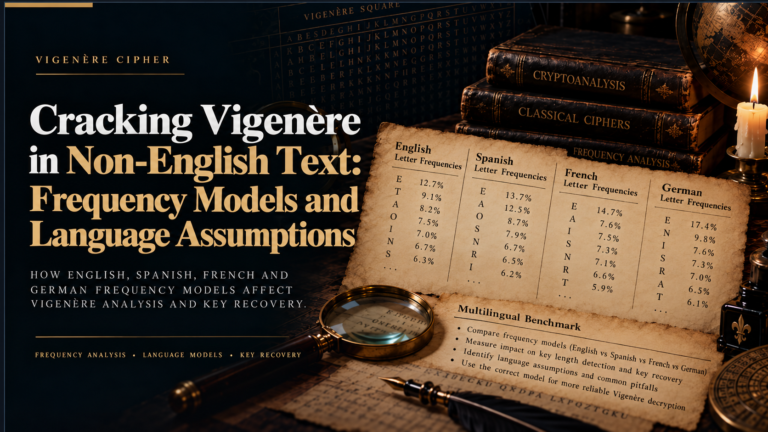
Non-English plaintext changes the baseline
Most classroom Vigenère analysis assumes English.
That affects the expected letter frequencies, the reference IC, frequency-scoring methods, and candidate plaintext ranking.
A French, German, Spanish, or other-language plaintext can produce different distributions.
Even specialized English can behave unusually. Source code, names, abbreviations, or constrained writing may not resemble ordinary prose.
If period splitting appears structurally correct but the columns do not match an English model well, consider whether the language assumption is wrong before rejecting the cipher.
A good detector should ask:
Does this look like language after accounting for a recurring shift?
not merely:
Does this look exactly like average English?
One-letter Vigenère is a special false negative
A Vigenère key containing one letter repeats every position.
For example:
Key: H
Shift: 7
produces:
H H H H H H H...
7 7 7 7 7 7 7...
That is exactly a Caesar shift of 7.
The ciphertext therefore preserves the ordinary language frequency shape rather than showing the flattened distribution normally associated with multi-letter Vigenère.
An identification system that defines Vigenère only as “low IC polyalphabetic text” can miss this edge case.
Mathematically, a one-letter Vigenère key collapses to Caesar.
For classification, it is usually more useful to call that ciphertext Caesar because that is its effective behavior.
The written key length may not be the effective period
Suppose someone uses:
ABCABC
as the written key.
Its length is 6, but the shift pattern is:
A B C A B C A B C...
The actual period is 3.
Statistical identification responds to the fundamental period of the keystream, not the number of characters someone happened to type into a key field.
This also explains why period candidates and their multiples often appear together.
If 5 is the true period, 10, 15, or 20 may preserve same-shift grouping as well. The smallest well-supported period is usually the one to investigate first.
A practical identification sequence
A disciplined analysis can be summarized without pretending that any stage is decisive by itself:
1. Normalize the text according to the likely cipher alphabet.

2. Inspect the character set and preserved formatting.
   Use this to rule out incompatible families, not to identify Vigenère.

3. Measure the whole-text frequency distribution and raw IC.
   Ask whether monoalphabetic substitution still looks plausible.

4. Search for repeated trigrams and longer sequences.
   Group overlapping matches from the same repeated block.

5. Record spacing factors from distinct useful repeat families.

6. Test candidate periods.
   Split the ciphertext by each period and calculate per-stream statistics.

7. Look for a period where several streams recover language-like unevenness.

8. Test the actual Vigenère shift model on those streams.
   Do candidate Caesar shifts align with the expected plaintext language?

9. Recombine the candidate shifts.
   Does one consistent repeating key produce coherent plaintext?

10. If the period is convincing but Vigenère arithmetic fails,
    investigate close periodic relatives instead of discarding the evidence.
The early steps establish the statistical case.
The later steps move from family-level identification toward confirmation.
That distinction prevents a detector from labeling every low-IC periodic cipher as Vigenère.
What should count as a positive identification?
For a long enough ciphertext, I would not call Vigenère strongly identified from only one of these observations:
“the frequencies look flat”

“IC is 0.043”

“I found a repeated trigram”

“period 6 gives a high average IC”
Any one can mislead.
A much stronger case is:
the complete distribution is consistent with polyalphabetic substitution

several distinct repeat families support the same period

that period restores language-like statistics in its columns

the columns can be explained by fixed Caesar-style shifts

those shifts repeat coherently across the message

the reconstructed key produces plausible plaintext
At that point, Vigenère is not merely a visual guess. It is a model that explains several properties of the ciphertext.
When the answer should remain “uncertain”
Sometimes the correct result of cipher identification is uncertainty.
Keep the classification open when the text is too short, the language is unknown, multiple periods look equally plausible, the ciphertext format has been heavily transformed, or Vigenère and a related periodic cipher explain the same initial evidence.
That is better analysis than forcing a label.
If the evidence does point strongly toward repeating-key Vigenère, the next problem is no longer identification. It is key recovery: determine the period confidently, solve the recurring Caesar-style streams, reconstruct the key, and verify the plaintext. That full process is covered in How to Break the Vigenère Cipher.
The useful principle is simple:
Do not identify Vigenère from how the ciphertext looks. Identify it from whether the ciphertext behaves the way repeating-key Vigenère predicts.
Editorially reviewed by VigenereDecoder.com editorial team