Is the Vigenère Cipher Secure? Strengths and Weaknesses
The traditional repeating-key Vigenère cipher is not secure enough for protecting modern sensitive information. Its polyalphabetic substitutions make it stronger than simple historical ciphers such as Caesar, but the repeated key introduces patterns that can be analyzed and exploited.
That does not mean every Vigenère ciphertext is equally easy to solve. A short message may provide too little evidence for reliable cryptanalysis, while a longer or less predictable key can make a particular example harder. Difficulty in one instance, however, is not the same as cryptographic security.
Vigenère is best understood today as a historical and educational cipher. It demonstrates an important lesson in cryptography: removing one obvious weakness can create a different form of structure that an attacker can use.
If you want to experiment with how different keys affect a message, the Vigenère Cipher Decoder and Encoder lets you encrypt and decrypt examples directly.
Security depends on what you expect the cipher to protect
The word secure needs context.
If the goal is merely to prevent someone from reading a message at a glance, Vigenère can still obscure ordinary text. Without the key, its ciphertext is not immediately readable to an untrained observer.
That is a much lower standard than modern cryptographic security.
A modern encryption system is expected to resist deliberate analysis by an attacker who knows how the system works. The secrecy of the method itself should not be what protects the message.
Traditional Vigenère does not meet that standard because its construction leaves exploitable relationships between repeated key positions and the underlying language.
| Question | Traditional Vigenère |
|---|---|
| Can it hide readable text from casual inspection? | Yes |
| Is it stronger than a single fixed Caesar shift? | Yes |
| Can its repeating structure be analyzed? | Yes |
| Should it protect genuinely sensitive modern information? | No |
Why Vigenère was a real improvement over simple substitution
The strength of Vigenère becomes clearer when it is compared with a monoalphabetic cipher.
A Caesar cipher uses one fixed shift throughout the entire message. If the plaintext letter E is shifted by three positions, every occurrence of E becomes H.
This preserves much of the underlying language pattern. Common plaintext letters remain common in the ciphertext, even though their identities have changed.
Vigenère works differently. Its key controls a changing sequence of shifts. The same plaintext letter can therefore produce different ciphertext letters depending on which key letter is aligned with it.
Instead of concentrating every occurrence of E into one ciphertext symbol, the cipher can spread those occurrences across several letters.
This makes ordinary whole-text frequency analysis less useful than it would be against a simple substitution cipher.
That improvement is genuine. The weakness appears not because polyalphabetic substitution is meaningless, but because of how the traditional Vigenère key is used.
The repeating key creates the central weakness
A traditional Vigenère key is usually shorter than the message, so the key starts again when its final letter is reached.
Suppose the key is:
The resulting keystream becomes:
The shifts are changing, but the sequence of changes is periodic. A five-letter key creates a five-position cycle.
Positions 1 and 6 use the same shift. So do positions 1, 11, 16, and every later position separated by five letters.
The same relationship exists for each position in the key.
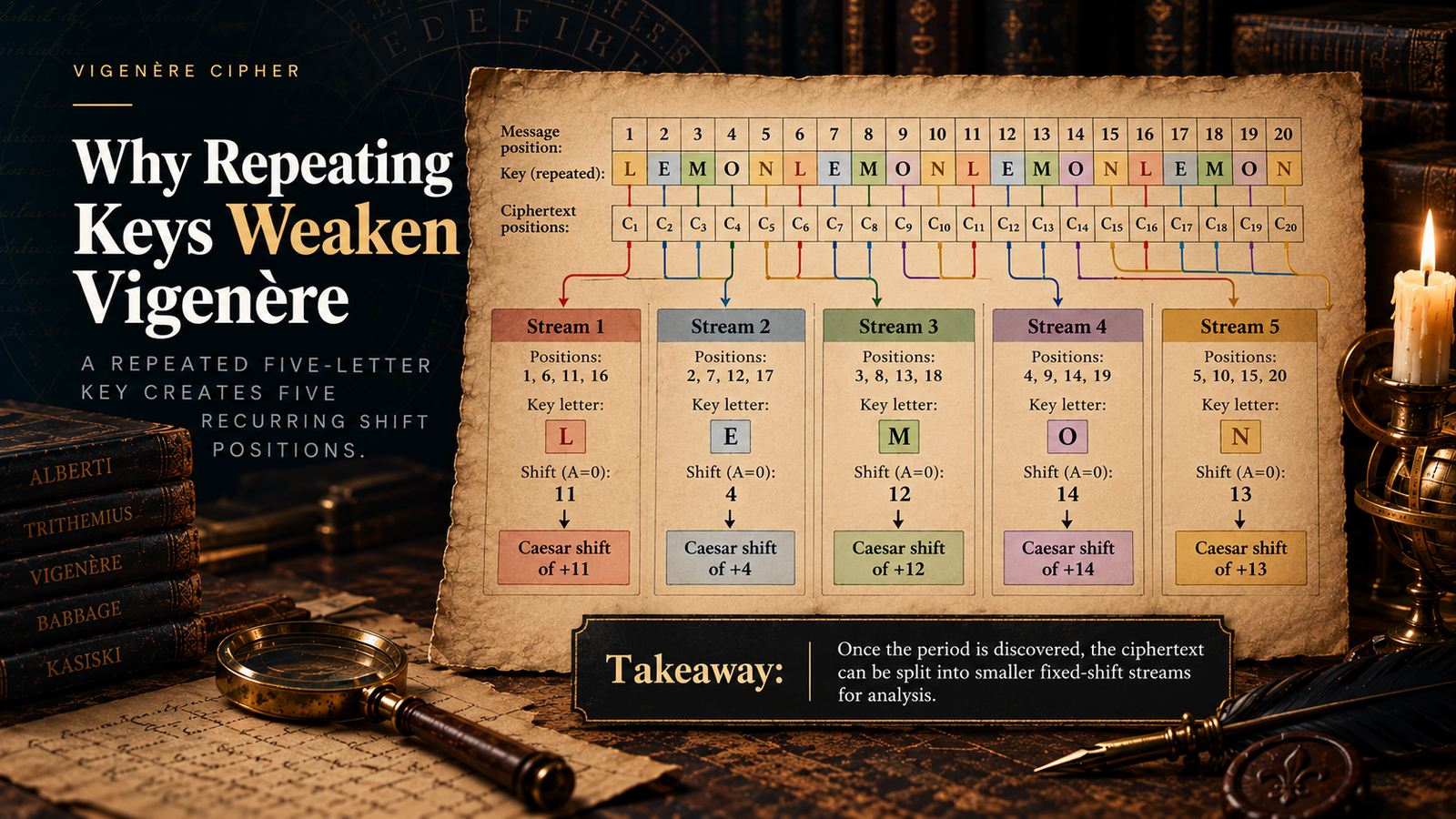
This periodic structure is the main reason classical cryptanalysis can attack repeating-key Vigenère.
If an analyst can estimate the period, the ciphertext can be separated according to key position.
| Key position | Ciphertext positions | Shift behavior |
|---|---|---|
| 1 | 1, 6, 11, 16… | Same fixed shift |
| 2 | 2, 7, 12, 17… | Same fixed shift |
| 3 | 3, 8, 13, 18… | Same fixed shift |
| 4 | 4, 9, 14, 19… | Same fixed shift |
| 5 | 5, 10, 15, 20… | Same fixed shift |
Instead of attacking one complicated polyalphabetic stream, the analyst can investigate several simpler streams, each produced by one recurring shift.
What happens after the period is discovered?
Finding the period does not instantly reveal the plaintext, but it changes the problem substantially.
Imagine a ciphertext encrypted with a five-letter key. Once five is identified as a likely period, every fifth character can be grouped together.
The distributions inside those groups can begin to resemble the statistical patterns of the original language, only shifted to different letters.
This is why the statement that Vigenère “defeats frequency analysis” is misleading when taken too far.
Vigenère makes simple whole-ciphertext frequency analysis much less effective. It does not permanently remove the statistical structure of the plaintext.
Methods used to investigate the period and recover the individual shifts are covered in How to Break the Vigenère Cipher .
Message length changes the practical difficulty
The weakness in the cipher does not guarantee that every individual ciphertext contains enough information for a reliable attack.
Statistical methods work better when they have enough observations.
Consider a 30-letter ciphertext encrypted with a six-letter key. If the correct period is six, separating the ciphertext gives only about five letters per key position.
Five letters provide very little evidence about normal language frequencies.
Now imagine a 600-letter ciphertext using the same six-letter key.
Each stream now contains far more material. Statistical patterns have a better chance of becoming visible.
This distinction explains an apparent contradiction that often causes confusion:
Both statements can be true at the same time.
Cryptographic security describes the construction. Practical attack difficulty also depends on how much useful evidence the attacker has.
A longer key helps, but it does not automatically solve the problem
Increasing the key length increases the distance before the same key positions repeat.
For a message of fixed length, a longer key also leaves fewer characters in each periodic stream. That can make classical statistical attacks harder.
But key length is only one part of the security picture.
A long key that repeats still creates a period. A human-chosen word or phrase may also be much more predictable than a uniformly random sequence. Reusing a key across several messages can expose additional relationships.
| Factor | Effect on practical analysis |
|---|---|
| Longer key | Extends the period and reduces samples per key position. |
| Short ciphertext | Provides less statistical evidence. |
| Long ciphertext | Provides more material for identifying repeated structure and language patterns. |
| Predictable key | May reduce the practical search difficulty. |
| Key reuse | Provides additional ciphertext produced from related key positions. |
There is also an important boundary here: a nonrepeating, message-length random key belongs to a different security model from ordinary repeating-key Vigenère. Simply making a memorable Vigenère keyword longer does not turn the traditional cipher into a modern secure system.
Key secrecy cannot compensate for a weak construction
A cipher should normally be evaluated under the assumption that an attacker understands how the algorithm works.
For Vigenère, the secret is the key, not the fact that Vigenère is being used.
Hiding the cipher method may inconvenience an attacker, but it should not be the security foundation.
Once the method is recognized, the repeating-key structure can be investigated directly.
This matters because classical puzzle ciphers sometimes appear secure only while the solver does not know which cipher produced the text. Identifying the method and breaking the key are two different problems.
Real cryptographic protection should remain strong even when the algorithm is public knowledge.
Other information can make Vigenère easier to attack
Ciphertext-only statistical analysis is not the only situation an attacker may encounter.
Human-chosen keys can be predictable. Portions of the plaintext may sometimes be known or reasonably guessed. The same key may be reused across several messages.
Each of these circumstances can provide information beyond the ciphertext itself.
They are important weaknesses, but they are separate attack topics and should not be confused with the central repeating-period problem.
The central security conclusion remains the same even without these advantages: repeating-key Vigenère already exposes enough structure to prevent it from being considered secure by modern standards.
Modern encryption is expected to do more than hide letters
Vigenère comes from an era when the main cryptographic problem was often framed as turning readable text into unreadable text.
Modern communication requires a broader security model.
Confidentiality is still important, but a recipient may also need to know whether the encrypted data was modified and whether it is authentic within the protocol being used.
Traditional Vigenère provides no built-in authentication or integrity mechanism.
| Security property | Traditional Vigenère |
|---|---|
| Obscures readable plaintext | Yes |
| Uses a secret key | Yes |
| Resists known classical cryptanalysis reliably | No |
| Detects message modification | No built-in mechanism |
| Authenticates the message or sender | No |
| Suitable for sensitive modern data | No |
This is why saying that Vigenère “encrypts” text is technically correct while saying that it provides appropriate modern data security would be misleading.
What Vigenère is still good for
Calling the cipher insecure does not make it useless.
Vigenère remains valuable precisely because its strengths and weaknesses are easy to observe.
It demonstrates how a key can control multiple substitution alphabets. It shows why a cipher that defeats one simple attack can still leak information in another way. It also provides a practical introduction to periodicity, letter-frequency analysis, modular arithmetic, and classical cryptanalysis.
These properties make it well suited to:
| Use | Appropriate? |
|---|---|
| Learning classical cryptography | Yes |
| Cryptography classes and demonstrations | Yes |
| Puzzles and recreational cipher challenges | Yes |
| Historical study | Yes |
| Protecting passwords or authentication data | No |
| Protecting private files or sensitive communication | No |
Using Vigenère in a puzzle is entirely different from relying on it for real confidentiality. In the first case, its breakable structure is often part of the point. In the second, that same structure is a liability.
Why the Vigenère security story still matters
The most useful lesson from Vigenère is not simply that an old cipher was eventually broken.
Its design addressed a genuine weakness in simpler substitution systems. Changing the shift throughout a message made basic frequency analysis substantially less direct.
The practical method used to control those changes, however, relied on repeating a relatively short key.
That repetition created a new pattern.
This is the reason the traditional Vigenère cipher should not be used for modern sensitive information. Its weakness is not merely that computers have become faster. The repeating-key construction itself exposes exploitable structure.
At the same time, that structure is exactly what makes Vigenère such a useful cipher to study. It shows how cryptographic strength depends on the whole design, not just on making the ciphertext look complicated.