Vigenère Cipher vs Caesar Cipher: Key Differences
The Caesar and Vigenère ciphers use the same basic operation: shift a plaintext letter through the alphabet. The important difference is how the shift is chosen.
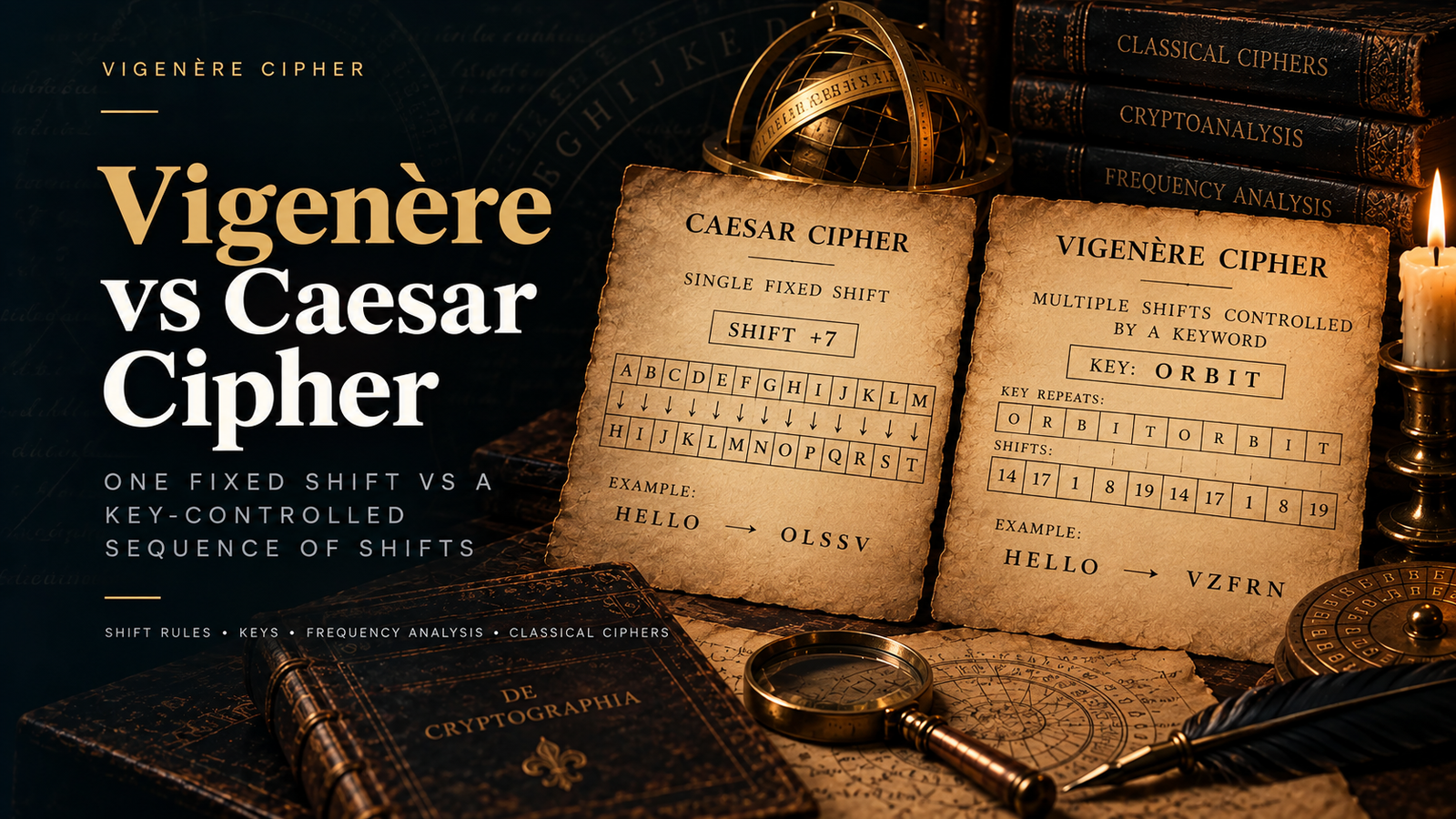
A Caesar cipher uses one fixed shift for the entire message. A Vigenère cipher uses a sequence of shifts controlled by a key, so the shift can change from one letter to the next.
That single design change has several consequences. It changes the relationship between repeated plaintext letters and ciphertext, changes what the key represents, and makes simple frequency analysis less effective against the ciphertext as a whole.
You can test Vigenère examples directly with the Vigenère Cipher Decoder and Encoder, but the clearest way to compare the two systems is to give them the same plaintext and watch what changes.
The difference in one table
| Feature | Caesar cipher | Vigenère cipher |
|---|---|---|
| Substitution type | Monoalphabetic | Polyalphabetic |
| Shift pattern | One shift throughout the message | Shift changes according to the key |
| Typical key | A number such as 7 | A word or sequence such as ORBIT |
| Repeated plaintext letter | Always receives the same substitution | Can receive different substitutions |
| Alphabet mappings used | One | Multiple |
| Simple whole-text frequency analysis | Strongly exposed | Disrupted by changing shifts |
| Traditional repeating-key weakness | Not applicable | The shift sequence eventually repeats |
The two ciphers are therefore related more closely than their different names suggest. Vigenère does not abandon Caesar-style shifting. It changes which Caesar shift is used at each position.
Put both ciphers on the same plaintext
Consider the plaintext:
First encrypt it with a Caesar shift of 7. Every letter moves seven positions forward:
The Caesar ciphertext is:
Now encrypt the same plaintext with the Vigenère key ORBIT. The key repeats as needed:
The Vigenère ciphertext is:
Nothing about the plaintext changed between the two examples. The difference came entirely from the shift rule.
Repeated letters reveal the difference immediately
The word BALLOON was chosen for a reason. It contains two consecutive L characters and two consecutive O characters.
Under the Caesar shift of 7:
Both occurrences of a plaintext letter produce exactly the same ciphertext letter because the same transformation is used everywhere.
Under Vigenère, those identical plaintext letters meet different key letters:
The plaintext has not stopped containing repeated letters. What has changed is the mapping between plaintext and ciphertext.
Caesar gives each plaintext letter one fixed ciphertext partner for a given key. Vigenère allows the partner to change according to the current position in the key.
This is the practical meaning of the terms monoalphabetic and polyalphabetic in this comparison.
The key is the real dividing line
A Caesar key answers one question:
If the answer is 7, the shift remains 7 from the first alphabetic character to the last.
A Vigenère key answers a different question:
Each key letter represents a shift. Using the standard A=0 through Z=25 convention:
The key ORBIT therefore describes the sequence:
When the traditional repeating-key form reaches the end of that sequence, it returns to the beginning.
That is why describing Vigenère merely as “a Caesar cipher with a word as the key” is incomplete. The word matters because it generates multiple shifts rather than one.
Mathematically, the two ciphers differ by one variable
Their relationship is especially clear when the letters are represented as numbers from 0 to 25.
Caesar encryption can be written as:
Here s is one fixed shift. It does not change as i moves through the message.
Repeating-key Vigenère can be written as:
In this expression, m is the key length and the selected K value changes with the position.
Caesar keeps the shift constant:
Vigenère can cycle through several shifts:
The arithmetic operation is essentially the same. The changing shift schedule is what changes the cipher.
A one-letter Vigenère key becomes a Caesar cipher
This relationship leads to a useful result.
Suppose a Vigenère key contains only the letter H.
Under the usual numbering, H=7. Repeating that one-letter key produces:
That is exactly the shift pattern of a Caesar cipher with key 7.
Using our earlier plaintext:
The outputs are identical.
This is more than a convenient analogy. A Caesar shift can be treated as a special case of the Vigenère operation where the key sequence contains only one repeating shift.
Once a Vigenère key contains different letters, the system moves beyond that single fixed substitution.
Why frequency patterns look different
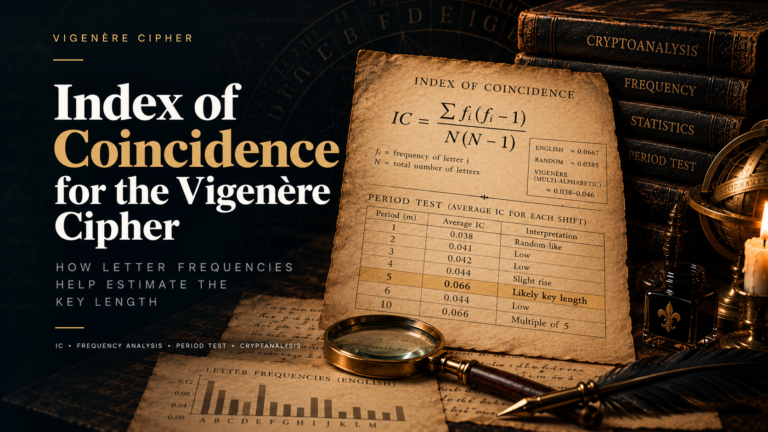
Natural language does not use every letter equally often. In English, some letters appear much more frequently than others.
Caesar changes the labels on those frequencies but not their distribution.
If a particular plaintext letter occurs 60 times, all 60 instances are shifted to the same ciphertext letter. The high-frequency peak survives in a different location.
Vigenère distributes those occurrences across different ciphertext letters whenever the plaintext positions align with different key letters.
Looking only at the complete ciphertext therefore makes ordinary single-alphabet frequency analysis less direct.
This does not make traditional Vigenère immune to cryptanalysis. Its repeating key creates a period, and once that period is identified, letters encrypted under the same key position can be grouped together. Each group then behaves much more like a Caesar-shifted stream.
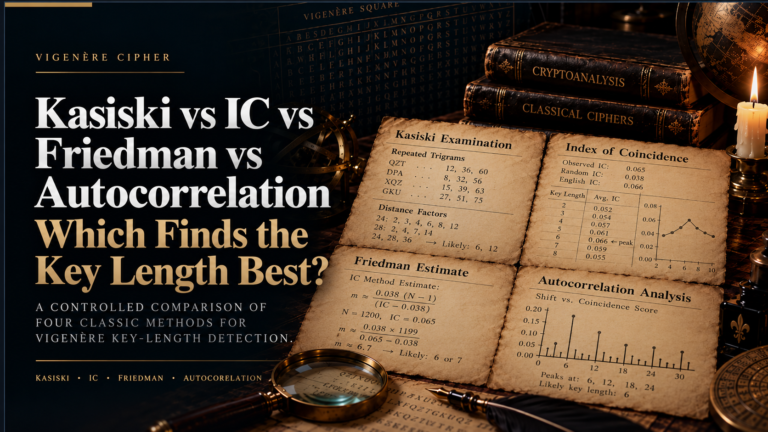
The process of exploiting that structure is covered separately in How to Break the Vigenère Cipher .
More possible keys do not change the basic comparison
Caesar has a very small set of possible shifts. With the standard 26-letter alphabet, there are 26 shift values if the identity shift of zero is included, or 25 nontrivial shifts that actually change the plaintext.
Vigenère can represent far more shift sequences because a key may contain several letters.
But comparing these ciphers only by counting keys misses the more useful distinction.
Caesar exposes a fixed substitution from beginning to end. Vigenère changes the substitution and therefore conceals simple whole-text frequency patterns more effectively.
At the same time, a traditional Vigenère keyword repeats, creating its own exploitable structure.
So the historical improvement is not simply “more keys.” It is a change from one substitution alphabet to a sequence of substitution alphabets.
Decryption shows the same structural difference
Both ciphers decrypt by reversing the shift used during encryption.
For Caesar, the same amount is subtracted from every ciphertext letter:
Vigenère also reverses the shifts, but the amount being subtracted changes with the key position:
This is why correct key alignment matters much more in Vigenère. If the key becomes offset by one position, the remaining shifts are wrong even if the key itself is correct.
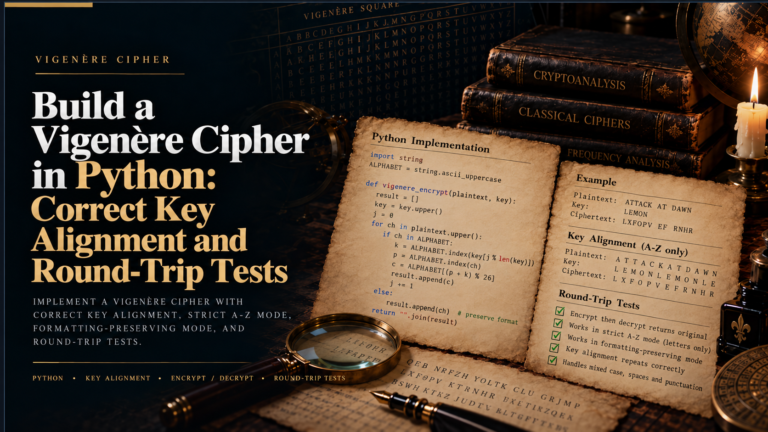
The full practical procedure for preparing the key and reversing the ciphertext is covered in How to Encrypt and Decrypt With the Vigenère Cipher .
Caesar is simpler to operate; Vigenère is more expressive
Caesar requires very little bookkeeping. Once the shift is known, every letter follows the same rule.
A person encrypting by hand can often work directly through the alphabet without writing a separate key line.
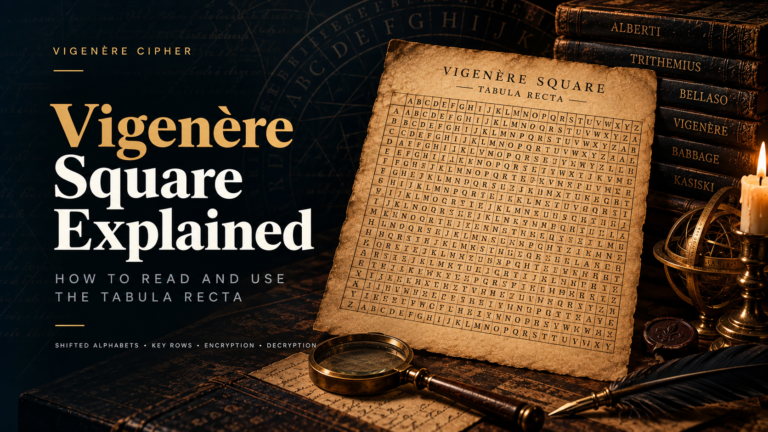
Vigenère requires the sender to keep the key aligned with the message and use the correct shift at each position. Traditionally, a Vigenère square can make those changing substitutions easier to perform by hand.
| Manual task | Caesar | Vigenère |
|---|---|---|
| Remember the key | One shift | Keyword or shift sequence |
| Track position | Usually unnecessary | Necessary for key alignment |
| Change substitution during message | No | Yes |
| Typical hand aid | Shifted alphabet or cipher wheel | Aligned key or Vigenère square |
Vigenère asks more of the person performing the cipher, but that extra complexity is what allows it to avoid one fixed plaintext-to-ciphertext mapping.
Neither cipher should be confused with modern encryption
Vigenère is substantially more sophisticated than Caesar in its use of changing substitutions, but the comparison is between two classical ciphers.
Caesar can be tested exhaustively because its shift space is tiny and its fixed substitution preserves language statistics directly. Traditional repeating-key Vigenère hides those statistics more effectively at first, but its periodic key provides another route for analysis.
The fact that Vigenère is stronger than Caesar should therefore not be interpreted as evidence that it is suitable for protecting modern sensitive information.
Its importance lies in what changed between the two designs: moving from one fixed alphabet shift to a key-controlled sequence of shifts was a major conceptual step in classical cryptography.
The most useful way to remember their relationship
Caesar and Vigenère are not two unrelated ideas.
Start with Caesar:
Then change one design decision:
That produces the central behavior of traditional Vigenère.
A Caesar cipher can therefore be understood as the one-shift edge case of the same alphabet-shifting idea. Vigenère extends that idea by allowing the shift to vary from position to position.
That difference explains nearly everything else in the comparison: why repeated letters behave differently, why whole-text frequency patterns are less obvious, why key alignment matters, and why Vigenère was an important development beyond simple monoalphabetic substitution.