History of the Vigenère Cipher
The history of the Vigenère cipher is more complicated than its name suggests.
The system commonly called the Vigenère cipher was not simply invented by Blaise de Vigenère in 1586. Its development came from earlier work on changing substitution alphabets, especially the systems associated with Leon Battista Alberti and Johannes Trithemius. Giovan Battista Bellaso described a closely related repeating-key system in 1553, decades before Vigenère published his own work. Vigenère later described a different and more sophisticated autokey cipher, but his name eventually became attached to Bellaso’s earlier system.
The later history is equally important. For centuries, the repeating-key system was regarded as exceptionally difficult to break. In the 19th century, Charles Babbage developed a method for attacking it, and Friedrich Kasiski published a general cryptanalytic procedure in 1863. The cipher’s reputation consequently changed from a difficult classical system to one whose periodic structure could be systematically exploited.
Understanding that sequence makes the name, design, reputation, and eventual cryptanalysis of the Vigenère cipher much easier to place in context.
Before Vigenère: the search for changing alphabets
Early substitution ciphers generally replaced plaintext letters according to a fixed relationship.
A monoalphabetic system has one substitution alphabet. Once an attacker identifies enough of its letter patterns, the underlying plaintext can often be investigated through frequency analysis.
Cryptographers in Renaissance Europe began looking for ways to avoid that predictable structure.
One important development came from Leon Battista Alberti, who described a method using multiple cipher alphabets in the 15th century. His approach used a cipher disk to switch between alphabets rather than relying on one fixed substitution throughout the message. This was an important step toward what would later be called polyalphabetic substitution.
The underlying idea was significant:
Instead of giving every plaintext letter one permanent ciphertext equivalent, the system could change the substitution being used.
That made straightforward frequency analysis substantially less effective.
The later Vigenère family of ciphers developed from this broader Renaissance effort to create changing substitution systems.
Johannes Trithemius and the tabula recta
Another major step came from Johannes Trithemius.
His Polygraphia, completed in manuscript form around 1508 and published in 1518, included a progressive polyalphabetic system and introduced the tabula recta, the table of shifted alphabets that later became closely associated with Vigenère.
The basic table consists of successive alphabet shifts:
The historical importance of this table is not simply that it makes encryption easier to calculate.
It provides a systematic way to represent multiple substitution alphabets.
Trithemius’s system, however, did not use an arbitrary repeating keyword in the same way as the later Bellaso system. Its progression followed a predetermined pattern.
That distinction matters.
The history of the Vigenère cipher is not the history of one person suddenly inventing the finished system. It is a sequence of related ideas:
Giovan Battista Bellaso and the 1553 system
The most important correction to the popular history of the Vigenère cipher concerns Giovan Battista Bellaso.
In 1553, Bellaso published La cifra del Sig. Giovan Battista Bellaso in Venice. His work described a polyalphabetic encryption method using a shared countersign or keyword to control the substitutions. Modern historical accounts identify Bellaso’s system as the direct ancestor of the cipher now commonly called the Vigenère cipher.
This predates Blaise de Vigenère’s major cryptographic publication by more than three decades.
Bellaso’s contribution was important because the changing substitutions were tied to an agreed keyword rather than simply following a fixed progression.
That made the sequence of substitutions dependent on a secret shared value.
The conceptual model became:
This is much closer to the traditional Vigenère system used today.
Historical research also shows that Bellaso continued developing related systems in later publications, including Novi et singolari modi di cifrare in 1555 and Il vero modo di scrivere in cifra in 1564.
Bellaso therefore occupies a central position in the actual development of the cipher, even though his name did not ultimately become attached to it.
What Bellaso actually contributed
Bellaso’s importance goes beyond simply having published an earlier version.
Earlier polyalphabetic systems had already demonstrated that changing alphabets could make substitution patterns harder to analyze.
Bellaso introduced a practical way to control those changes using a countersign, effectively allowing correspondents to agree on a key outside the ciphertext itself.
This made the cipher more flexible.
Instead of every message following one predetermined sequence, the correspondents could select a different key.
For example, the underlying method could use:
The cipher’s structure remained the same, but the substitution sequence changed with the agreed key.
This principle is one of the reasons Bellaso’s system is so closely connected to the modern Vigenère cipher.
There were nevertheless technical differences between Bellaso’s original construction and the standardized 26-letter repeating-key Vigenère system commonly taught today. Historical sources therefore often describe Bellaso’s method as the ancestor or original form rather than treating the two systems as literally identical.
Blaise de Vigenère enters the story
Blaise de Vigenère was a French diplomat, cryptographer, translator, and writer who lived from 1523 to 1596.
His connection to cryptography developed partly through his diplomatic work and exposure to earlier European cryptographic literature. During a diplomatic mission to Rome, he encountered writings on cryptography by earlier authors including Alberti, Trithemius, and others.
Vigenère later produced his own substantial work on cryptography:
Traicté des chiffres ou secrètes manières d’escrire.
It was published in 1586.
This is where the historical naming problem becomes especially important.
Vigenère did write about a system resembling what later became known by his name.
But the system he is most closely associated with in his own work was not simply the modern repeating-key Vigenère cipher.
Vigenère developed an autokey cipher, in which the key material is extended using plaintext information rather than merely repeating a short keyword indefinitely.
That distinction is frequently lost in simplified histories.
Why is it called the Vigenère cipher?
The name became attached to the cipher through later historical attribution rather than because Vigenère was the sole inventor of the exact system now taught under his name.
Bellaso had described a closely related repeating-key polyalphabetic system in 1553.
Vigenère published his own cryptographic work in 1586 and included related material.
Over time, the name Vigenère cipher became established for the repeating-key system.
Modern historical references therefore describe the cipher as having been misattributed to Vigenère. EBSCO’s historical overview explicitly identifies Bellaso’s 1553 description and notes that the system was later attributed to Vigenère, while historical research on the original sources also documents the relationship between Bellaso’s table and Vigenère’s later work.
The naming can therefore be summarized as:
The name is now firmly established, even though the historical attribution is more complicated.
Vigenère’s own cipher was different
This distinction deserves its own section because it prevents one of the most common historical errors.
The traditional repeating-key Vigenère cipher uses a short key repeatedly:
Vigenère’s autokey approach instead extends the key using additional information from the message itself.
The two systems are related because both belong to the broader family of polyalphabetic substitution methods.
They are not the same construction.
Historical sources note that Vigenère’s 1586 work described an autokey system, while the cipher now carrying his name is based more directly on Bellaso’s earlier system.
This is one reason simply saying “Blaise de Vigenère invented the Vigenère cipher in 1586” is historically incomplete.
A more accurate description is that the cipher now called Vigenère developed from earlier polyalphabetic work, with Bellaso’s 1553 system being especially important, while Vigenère later published related and distinct cryptographic methods in 1586.
Why polyalphabetic ciphers mattered
The attraction of these systems becomes clearer when viewed against the cryptanalysis of the period.
A simple substitution cipher creates a stable relationship:
Every occurrence of the same plaintext letter receives the same ciphertext letter.
A polyalphabetic cipher changes that relationship according to the current key position.
The same plaintext letter can therefore become different ciphertext letters.
That makes the ciphertext’s frequency distribution less directly representative of the underlying plaintext.
The development of changing alphabets was consequently part of a broader effort to make cryptographic messages more resistant to the analytical methods available at the time.
The Renaissance history of cryptography includes several such attempts, with Alberti, Trithemius, Bellaso, della Porta, and Vigenère contributing different ideas to the development of polyalphabetic systems.
The reputation of an “indecipherable” cipher
The traditional Vigenère system eventually acquired a formidable reputation.
Because the cipher could use different substitution alphabets rather than one fixed alphabet, ordinary frequency analysis was much less immediately effective.
This led to the famous historical description “le chiffre indéchiffrable”, meaning “the indecipherable cipher.” Historical accounts associate this reputation with the cipher’s long-standing resistance to conventional cryptanalysis.
The reputation was understandable within the context of the time.
A monoalphabetic cipher could expose a relatively stable frequency pattern.
A repeating-key Vigenère cipher distributed the plaintext through multiple substitution alphabets.
But “indecipherable” did not mean mathematically unbreakable.
The eventual weakness was the repetition of the key itself.
That periodic structure provided the information later cryptanalysts needed.
Charles Babbage and the first major breakthrough
The 19th century brought a major change in the history of the cipher.
Charles Babbage developed a method for attacking the repeating-key Vigenère system in the 1850s.
Historical accounts credit Babbage with discovering a successful cryptanalytic method by 1854, although he did not publish the method at the time.
This is historically significant because it means the cipher’s practical cryptanalytic defeat predates the publication for which Friedrich Kasiski later became famous.
Babbage recognized that repeated patterns in the ciphertext could reveal information about the repeating key.
Once the period of the key could be inferred, the cipher could be separated into simpler streams, making frequency-based analysis possible again.
The basic conceptual progression was:
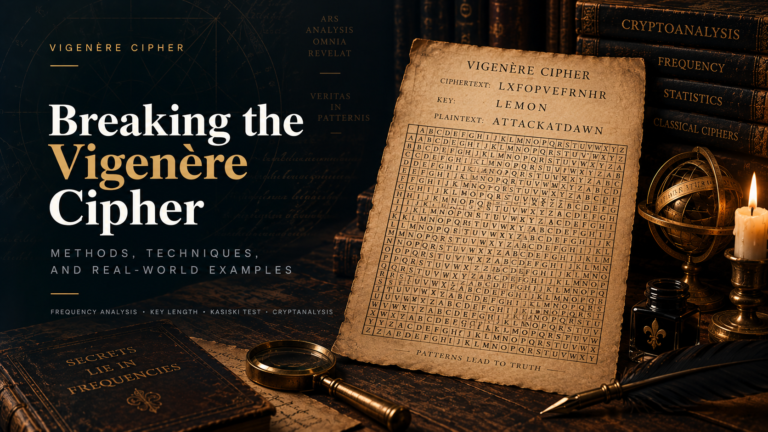
That is essentially the foundation of the classical attack discussed in How to Break the Vigenère Cipher .
Friedrich Kasiski and the 1863 publication
Friedrich Wilhelm Kasiski, a Prussian infantry officer and cryptanalyst, independently developed and published a systematic method for attacking the Vigenère cipher.
His book Die Geheimschriften und die Dechiffrir-Kunst was published in 1863.
The method became known as the Kasiski examination. It uses repeated ciphertext sequences and the distances between them to obtain clues about the length of the repeating key.
Kasiski’s publication was historically important because it made the attack method available in print.
This is why Kasiski is often associated with the breaking of the Vigenère cipher even though Babbage had already discovered a related method years earlier.
The distinction is:
The two names therefore represent different parts of the same turning point in Vigenère cryptanalysis.
Why Kasiski’s method worked
The repeating key created a periodic structure.
Suppose a key has five letters:
Every fifth alphabetic position uses the same key position.
If a repeated plaintext sequence happens to begin at positions aligned with the same point in the key cycle, its ciphertext representation can also repeat.
The distance between those repeated ciphertext sequences may therefore contain a factor related to the key length.
That observation transformed the attack.
Instead of trying to guess an unknown keyword blindly, the cryptanalyst could first investigate the period of the key.
Once the period was estimated, the polyalphabetic cipher could be decomposed into several Caesar-like substitution problems.
The same structural weakness is why modern explanations of Vigenère cryptanalysis still begin with key-length analysis.
The transition from “unbreakable” to classical cryptanalysis
The history of the Vigenère cipher therefore contains a striking change in reputation.
During its earlier history, changing substitution alphabets represented a significant improvement over fixed substitution.
The repeating-key system could obscure the ordinary frequency patterns that made monoalphabetic substitution vulnerable.
But the key repetition eventually became the source of a new attack.
The chronology can be simplified as:
The dates matter because they show that the cipher was the product of several stages of cryptographic development, not a single invention.
The role of the Vigenère square in its history
The Vigenère square is another part of the story that predates the name “Vigenère.”
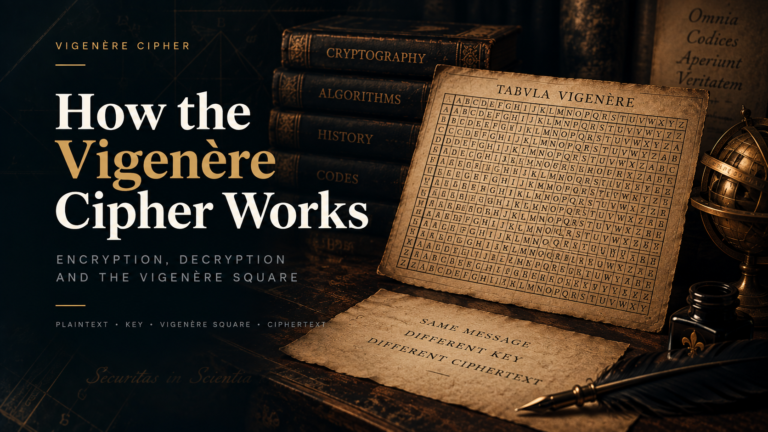
The underlying concept of a tabula recta is associated with Trithemius’s Polygraphia. Later systems adapted the idea for their own polyalphabetic constructions.
By the time the repeating-key Vigenère system became standard in educational descriptions, the square had become one of its most recognizable features.
Its historical importance is therefore broader than the Vigenère cipher itself.
It represents a practical way of arranging multiple shifted alphabets so that encryption and decryption can be performed systematically.
This is another reason the historical development is better understood as a chain of related systems rather than a single invention.
Bellaso’s place in the modern name
The modern name creates an unusual historical situation.
The person whose name appears on the cipher was not the person who first described the exact repeating-key system that later became associated with that name.
Bellaso’s contribution was largely absorbed into the later history of the cipher.
Vigenère’s name became dominant because of his prominent cryptographic publication and the subsequent development of terminology.
Historical scholarship has therefore spent considerable effort separating:
- Bellaso’s original system;
- Vigenère’s own autokey system;
- the later repeating-key cipher;
- and the historical process by which the name “Vigenère” became attached to it.
The distinction is not merely academic. It changes how the origin of the cipher should be described.
How the cipher reached modern cryptography education
Although the traditional Vigenère cipher is no longer considered suitable for protecting modern confidential information, it remains useful for teaching several fundamental cryptographic concepts.
It provides a compact example of:
- substitution;
- polyalphabetic encryption;
- key-based transformation;
- modular arithmetic;
- periodicity;
- frequency analysis;
- cryptanalysis; and
- the difference between encryption and cryptanalysis.
Its historical development also provides a useful example of how cryptographic systems evolve.
A technique can be created to solve one weakness, only for its own structure to introduce another weakness that later cryptanalysts exploit.
The Vigenère cipher illustrates that progression particularly clearly.
From historical cipher to educational tool
Today, the traditional Vigenère cipher is primarily encountered in historical study, cryptography education, puzzles, programming exercises, and demonstrations of classical cryptanalysis.
Its importance is therefore not based on modern security.
It is valuable because its structure is simple enough to understand completely while still demonstrating several ideas that remain central to cryptography.
A learner can move from:
to:
The same cipher therefore provides an introduction to both encryption and cryptanalysis.
What the history of Vigenère tells us about the cipher
The name “Vigenère cipher” describes the modern identity of a system whose development was shared across several generations of cryptographers.
Alberti helped establish the idea of changing cipher alphabets.
Trithemius provided an important tabular framework for polyalphabetic substitution.
Bellaso introduced a closely related keyword-controlled system in 1553.
Vigenère published his own cryptographic work in 1586, including an autokey system that was distinct from the repeating-key cipher later named after him.
Babbage discovered a successful method for attacking the repeating-key system in the 1850s.
Kasiski independently developed and published a systematic cryptanalytic method in 1863.
The modern Vigenère cipher is therefore best understood as the result of a long development in classical cryptography, followed by an equally important development in cryptanalysis.
Vigenère cipher historical timeline
The major developments can be placed on one timeline:
| Period | Development |
|---|---|
| c. 1460s | Leon Battista Alberti describes an early multiple-alphabet cipher system. |
| 1518 | Johannes Trithemius’s Polygraphia is published, including the tabula recta and a progressive polyalphabetic method. |
| 1553 | Giovan Battista Bellaso publishes La cifra, describing a closely related keyword-controlled polyalphabetic system. |
| 1555 | Bellaso publishes additional cipher systems in Novi et singolari modi di cifrare. |
| 1564 | Bellaso publishes Il vero modo di scrivere in cifra. |
| 1586 | Blaise de Vigenère publishes Traicté des chiffres ou secrètes manières d’escrire, including his own autokey system. |
| 1850s | Charles Babbage develops a successful method for attacking the repeating-key Vigenère system. |
| 1863 | Friedrich Kasiski publishes a systematic method for Vigenère cryptanalysis. |
| Modern era | The traditional Vigenère cipher becomes primarily an educational and historical example of polyalphabetic cryptography. |
The timeline reflects the distinction between the historical development of polyalphabetic systems and the later attribution of the repeating-key cipher to Vigenère.
Why the name remains “Vigenère”
Despite the historical attribution issue, Vigenère cipher is now the established name for the traditional repeating-key system.
Changing the name would not change the algorithm, its history, or its cryptanalytic properties.
The important point for anyone studying the cipher is simply to understand the distinction:
This gives a more accurate picture than the simplified statement that Vigenère personally invented the entire system in 1586.
The historical significance of the cipher
The Vigenère cipher occupies an important position in the history of cryptography because it sits between simple substitution systems and later, more systematic approaches to cryptographic design and analysis.
Its development demonstrates the progression from:
The cipher is therefore historically useful for two reasons.
It demonstrates an important advance in encryption design.
And it demonstrates how the structure of that advance eventually created a new avenue for cryptanalysis.
That combination is what makes the Vigenère cipher more significant than a simple historical puzzle cipher.
Continue learning about the Vigenère cipher
If you want to understand the cipher itself before exploring its history, read What Is the Vigenère Cipher?
For the mathematical and operational mechanics, see How Does the Vigenère Cipher Work?
If you want to perform encryption or decryption with a known key, read How to Encrypt and Decrypt With the Vigenère Cipher .
If you want to understand how the repeating-key system can be attacked, continue with How to Break the Vigenère Cipher .
You can also use the Vigenère Cipher Decoder and Encoder on the homepage to experiment with the cipher directly.